Would You Rather_Gaza Or No Gaza/ The Problem with Asking the Wrong Question
R Nico Socolovsky / Parashat Beshalach
Who doesn’t love a good Would You Rather? But even the best ones often have a hidden sting. Sometimes, it’s not about choosing what you want—it’s about choosing what you can live with.
Would you rather always feel like there’s a pebble in your shoe or have an itch you can never quite scratch?
Would you rather relive your most embarrassing moment once a week or have a stranger insult you every day?
Would you rather lose your ability to taste food or never be able to listen to music again?
Parashat Beshalach brings this dilemma to life in the most real way possible:
Exodus 14:9
“The Egyptians pursued them and overtook them encamped by the sea—all of Pharaoh’s chariots, horsemen, and army—by Pi-hahiroth, before Baal-Zephon.”
The Israelites were trapped…
Would you rather face Pharaoh’s army or throw yourself into the sea? An impossible choice.
It was hard to believe that the mighty sea could split. In fact, the Midrash tells us that the sea actively resisted:
As Moses stood before the sea, staff in hand, he commanded it to split in God’s name. But the sea scoffed, “I was created on the third day—you, humanity, came on the sixth. Who are you to command me?” (Shemot Rabbah 21:6).
The Chassidic Master Kedushat Levi explains that nature, after fulfilling its role for so long, can begin to see itself as independent. So God humbled the sea—not just splitting it, but forcing it to dry up completely with a mighty east wind (ruach kadim azah), stripping it of its pride.
This is why the Israelites began their song with כי גאה גאה—“He has triumphed gloriously.”
As the Israelites crossed, the Egyptians drowned behind them. The ministering angels prepared to sing in praise. But the Holy One, Blessed be He, stopped them, saying:
“My children are drowning in the sea, and you are singing before Me?”
The angels fell silent. Though justice was served, God did not rejoice in destruction. But Rabbi Yosei bar Ḥanina adds a striking nuance: while God does not celebrate the downfall of the wicked, He allows others to rejoice. The Israelites, standing on the shore, were not chastised for their song. Their joy was not in the suffering of their enemies, but in their own miraculous salvation. Justice had been done—but the heavens remained solemn.
This week, President Trump stood before the nation and essentially posed a Would You Rather:
Gaza, or no Gaza?
And thousands of voices, compelled by the idea of a huge challenge simply disappearing, got excited.
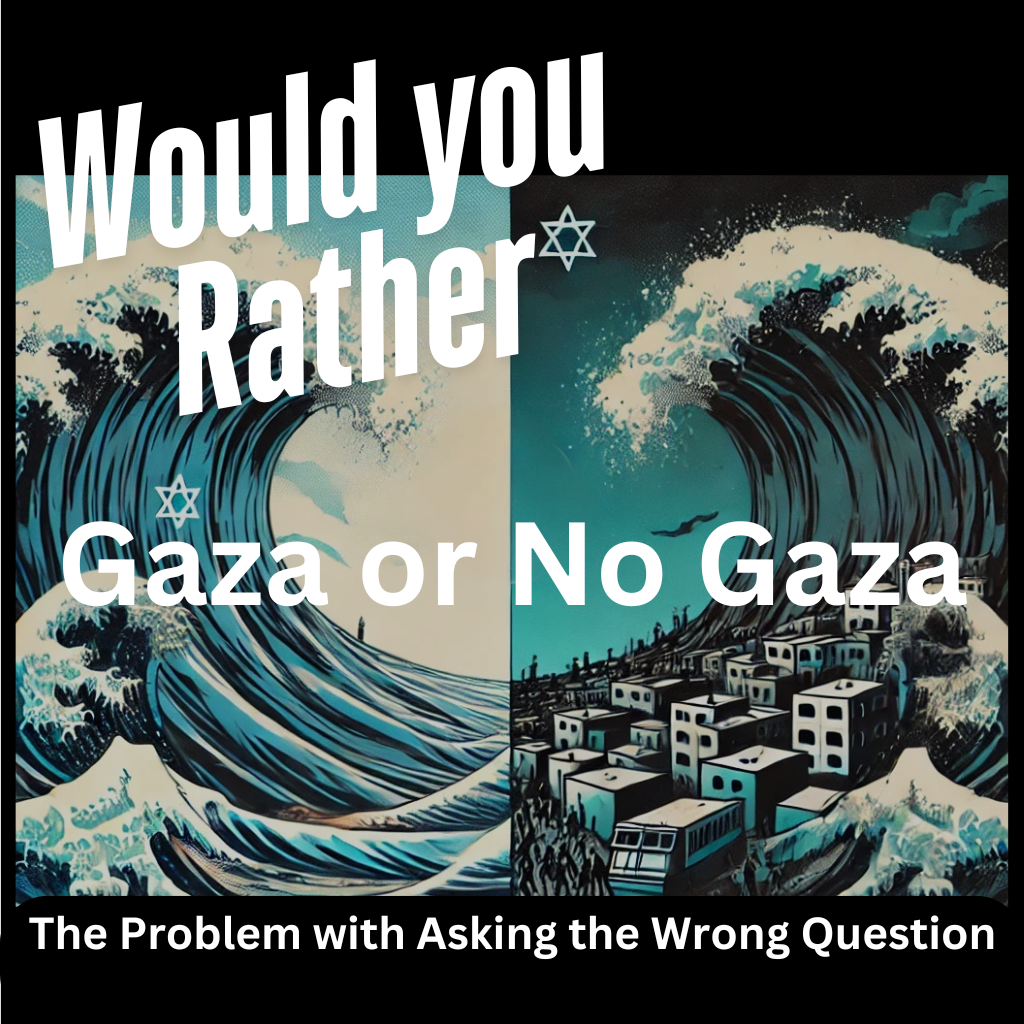
But this was not like Moses raising his hand and God splitting the sea; it was more like suggesting to vaporize it—for its own good.
Some have told me:
“This is a great conversation starter. Now that the idea is on the table, those who didn’t want to get involved will engage.”
Others have said:
“What’s the big deal? It’s just a fantasy. Aren’t we allowed to have fantasies?”
And some have argued:
“It’s nearly impossible to rebuild Gaza given the destruction and the tunnel system beneath. Relocating its people might actually be a good idea.”
I don’t know.
In Israel, a survey showed that almost 90% of the population favors the idea—but only 30% think it’s actually realistic.
So, is this real or not? Hard to say.
I’d like to offer three ideas I’ve been reflecting on over the past few days and invite you to think along with me:
- Empathy for Our People
Before we judge Israelis who support something that could be considered ethnic cleansing, let’s acknowledge a painful truth: most of us prefer to choose our neighbors.
Imagine waking up on the morning of October 7th, assaulted, tortured, abducted, and witnessing loved ones murdered—by your neighbors. Wouldn’t the idea of sending them as far away as possible feel compelling?
- You Have to Measure with the Same Scale
Deuteronomy 25:14
“You shall not have in your house alternate measures, a larger and a smaller.”
Whether or not this idea is realistic, we must ask: is it morally acceptable?
What are the implications of legitimizing population transfers? And from a self-preservation perspective—could this approach backfire?
If we say that a population living on a small strip of land, constantly causing problems for its larger and more powerful neighbor, can be removed for the sake of security—
What happens when we zoom out?
Israel itself is a small strip in the Middle East. Could someone in the U.S. government one day make the same argument about Israel? Could they echo the rhetoric we heard on college campuses last year and say: “Jews should go back to Europe”? - It’s Hard to Imagine the Sea Can Split
We don’t really want to see the Palestinian people leave their homes.
What we really want is peace.
But it feels impossible to imagine.
Would you rather have a future where Israel and Gaza coexist—or one where one side disappears?
Would you rather believe peace is possible—or believe destruction is inevitable?
The sea did not part on its own. It took an act of faith, of courage, of stepping forward before the waters split.
Maybe our greatest challenge is not choosing between two impossible options—
but choosing to believe there is another way.
 Po Ve Sham